
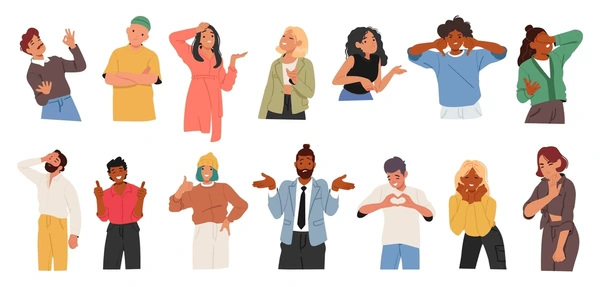
The landscape of professional communication has undergone a seismic shift. In 2026, we are no longer just talking to each other; we are communicating across a complex matrix of physical boardrooms, high-definition video calls, asynchronous text channels, and AI-mediated summaries. The old rules of “firm handshakes” and “eye contact” have not disappeared, but they have been complicated by a new layer of digital nuance. We are living in the era of “Hybrid Presence,” where your ability to project confidence, empathy, and clarity must translate equally well through a 4K webcam as it does in a face-to-face meeting. Furthermore, with Artificial Intelligence now acting as a silent participant in almost every interaction—transcribing our meetings, analyzing our sentiment, and suggesting our email replies—the value of authentic human signal has never been higher. To succeed today, professionals must become “bilingual,” fluent in both the biological language of the body and the digital language of the screen. This guide explores the advanced mechanics of communication in the modern workplace, dissecting how to build trust, command authority, and foster deep connection in an environment designed to distract us.
The Evolution of “Digital Body Language”
For decades, body language experts focused on posture, gestures, and proxemics (the use of space). In 2026, we must add “Digital Body Language” to this lexicon. This is the aggregate of your digital signals: your response time to a Slack message, your use of emojis to convey tone, your camera angle during a Zoom call, and even your “mute button discipline.” In a remote-first or hybrid world, anxiety often stems from the absence of physical cues. When we cannot see a colleague’s crossed arms or furrowed brow, we tend to assume the worst. Therefore, modern communication requires “Explicit Signaling.” You cannot just be listening; you must show you are listening. On a video call, this means exaggerated nodding, using the “thumbs up” reaction to validate a speaker without interrupting, and maintaining “camera eye contact”—looking directly at the lens rather than the screen. This unnatural behavior is necessary because the camera flattens us. To convey 100% of an emotion digitally, you often have to project at 120%. Conversely, silence in a digital context is heavy. If you read a message and do not reply for four hours, the sender may interpret that as passive-aggression. The new etiquette requires a “receipt of acknowledgment”—a quick emoji or a “Saw this, will reply later” note—to close the anxiety loop.
Mastering the “Hybrid Meeting” Dynamic
The most difficult communication environment in 2026 is the “Hybrid Meeting,” where half the participants are in a conference room and half are dialling in remotely. This creates a two-tier system where the people in the room naturally dominate the conversation due to “Proximity Bias.” The remote participants are often reduced to pixelated tiles on a wall screen, easily ignored. Mastering this dynamic requires “Inclusion Mechanics.” If you are the leader in the room, your body language must be “Bridge-Building.” You must physically turn your body toward the screen when addressing remote attendees, effectively treating the camera as another person in the room. You must also enforce a “Digital-First” speaking order, asking remote participants for their input before the people in the room. For the remote participant, the challenge is “Presence Projection.” You cannot be a passive observer. You must use “interruption signals”—raising your digital hand or unmuting your mic 2 seconds before you speak—to claim space. Your audio quality becomes your proxy for authority. In 2026, a high-quality microphone is not a tech accessory; it is a wardrobe essential. If you sound tinny or distant, your ideas will be perceived as weak. If you sound rich and clear, you command subconscious respect.
The “AI Interpreter” in the Room
We are increasingly communicating through AI. Real-time translation tools now allow a manager in Tokyo to speak Japanese while her team in London hears English. Meeting assistants like Otter.ai or Microsoft Copilot generate summaries that often become the official record of what was said. This changes how we must speak. We must now “Speak for the Record.” This means prioritizing clarity and structure over nuance and sarcasm. AI struggles with irony and subtle jokes; it takes them literally. To ensure your points are captured accurately by the algorithm (and thus remembered by your team), use “Signposting.” Explicitly state: “The three key takeaways are…” or “My decision on this is…” This is “Algorithmic Optimization for Speech.” It ensures that when the AI summarizes the meeting, your contributions are highlighted as action items rather than disregarded as chatter. However, this creates a risk of “Performative Communication,” where people speak just to be logged by the bot. The antidote is “Deep Listening”—the uniquely human ability to read the room, sense the hesitation in a pause, and ask the question that the AI transcript would miss: “I hear you saying yes, but your tone suggests you have reservations. Can we explore that?”
Emotional Intelligence and “Micro-Expressions”
As machines take over the logical processing of information, the premium on Emotional Intelligence (EQ) has skyrocketed. The ability to read “Micro-Expressions”—the fleeting, involuntary facial expressions that reveal true emotion—is a superpower. In high-definition 4K video, these are visible if you are paying attention. A tightening of the lips, a quick eyebrow flash, or a micro-shrug can tell you more than a ten-minute monologue. In 2026, “Empathy Surveillance” is a necessary skill. You must constantly scan the faces of your team (whether on screen or in person) for signs of burnout, disengagement, or confusion. When you spot a disconnect, you must switch from “Broadcast Mode” (talking at them) to “Reception Mode” (inviting them in). This involves “Verbal Mirroring”—repeating the last three words a person said to show you are tracking them—and “Labeling”—tentatively identifying their emotion (“It seems like you are frustrated by the timeline”). These techniques, borrowed from hostage negotiation, lower defensive barriers and foster psychological safety, which is the bedrock of all effective collaboration.
The Art of Asynchronous Communication
Not every conversation needs a meeting. In fact, the hallmark of a high-performance team in 2026 is “Asynchronous Fluency”—the ability to communicate complex ideas without being online at the same time. This requires a shift from “talking” to “writing.” However, this is not about writing long, dense emails. It is about “Visual Brevity.” The modern professional scans; they do not read. Your async updates (on Slack, Teams, or Loom) must be structured like a news article: Headline first, then the “TL;DR” (Too Long; Didn’t Read) summary, then the details. Use bullet points, bold text for action items, and screen recordings to show rather than tell. A 2-minute Loom video where you walk through a spreadsheet is infinitely more effective than a 500-word email explaining it. The body language of async text is “Tone Management.” Text is naturally cold. To warm it up without being unprofessional, use “Softening Agents”—phrases like “Just wanted to clarify…” or “Thanks for the great work on this…” The judicious use of emojis is no longer unprofessional; it is a necessary tool for “Tone Disambiguation,” ensuring that a direct request (“Do this by 5pm”) is read as urgent, not angry.
Public Speaking and the “Digital Stage”
Public speaking has evolved into “Hybrid Presenting.” Whether you are pitching to a client or leading a town hall, you are likely addressing a mixed audience. The old style of pacing the stage works for the room but makes the remote viewer dizzy. The new style is “Anchored Dynamism.” You must plant your feet to stay in the camera frame but use your upper body and voice to generate energy. “Vocal Variety”—changing your pitch, pace, and volume—is critical when you cannot use physical movement to hold attention. You must also master the “Second Screen Experience.” Your audience is likely checking their phones or emails while you speak. You cannot fight this; you must work with it. Use “Visual Hooks” on your slides—high-impact images or shocking data points—to drag their eyes back to the screen. Ask “Poll Questions” or use interactive tools like Mentimeter to force them to engage with their devices in a way that supports your presentation. The goal is to turn the distraction device into a participation device.
Cross-Cultural Communication in a Globalized Workforce
Globalization has digitized, meaning we are interacting with diverse cultures more frequently than ever. “Cultural Intelligence” (CQ) is the ability to adapt your communication style to different norms. In “Low-Context” cultures (like the US or Germany), communication is explicit and direct; “Yes” means “Yes.” In “High-Context” cultures (like Japan or parts of the Middle East), communication is implicit and relies on shared history; “Yes” might mean “I hear you,” not “I agree.” In 2026, failing to recognize these differences causes massive friction. You must learn to “Code-Switch.” When working with a Dutch team, direct feedback is appreciated and seen as honest. When working with an Indian team, that same feedback might be seen as rude and demoralizing. You must learn to read the “Silence.” In some cultures, a pause after a proposal is a sign of thoughtful consideration; in others, it is an awkward void to be filled. The skilled communicator waits. They use “Global English”—simplified vocabulary, no idioms (avoid “hit it out of the park”), and slower pacing—to ensure inclusion for non-native speakers.
“Radical Candor” and Feedback Loops
The speed of business in 2026 requires rapid feedback loops. We cannot wait for the annual review. We need “Radical Candor”—the ability to Challenge Directly while Caring Personally. This is a delicate communication balance. If you challenge without caring, you are just aggressive. If you care without challenging, you are “ruinously empathetic.” The body language of feedback is “Openness.” Uncross your arms, lean in slightly, and maintain soft eye contact. Use the “Data-Observation-Impact” model. Instead of saying “You were rude in the meeting,” say “When you interrupted X three times (Data), I noticed the team stopped sharing ideas (Observation), which puts our project at risk (Impact).” This removes the personal attack and focuses on the shared goal. Furthermore, you must actively solicit feedback. Ask specific questions: “What is one thing I could have done differently in that meeting to help you?” This vulnerability signals that you are a learner, not just a critic, and creates a culture where feedback flows in both directions.
De-Escalation and Crisis Communication
In a high-pressure, always-on environment, conflict is inevitable. The ability to De-Escalate is a vital safety valve. When a colleague is angry or a client is shouting, your body language must be the “Thermostat,” not the “Thermometer.” Do not reflect their heat; lower the temperature. Use “Calming Signals”: lower your voice volume, slow your rate of speech, and keep your hands visible and open (a primal signal of non-threat). Acknowledge their emotion before arguing the facts. “I can see you are incredibly frustrated by this delay, and you have every right to be.” This “Validation” often pops the balloon of their anger, allowing you to pivot to problem-solving. In a digital crisis (e.g., a Slack flame war), the best move is to “Change the Channel.” Do not type back. Pick up the phone or start a video call. The human voice carries nuance that text cannot, and 90% of digital conflicts evaporate once humans act like humans again.
Conclusion: The “Signal-to-Noise” Ratio
Ultimately, effective communication in 2026 is about managing your “Signal-to-Noise” ratio. The corporate world is noisy—filled with notifications, AI summaries, and endless chatter. To be heard, you do not need to shout louder; you need to transmit a clearer signal. This means stripping away the corporate jargon, the passive-aggressive silence, and the performative busyness. It means using your body, your voice, and your digital tools to convey Intent, Empathy, and Clarity. Whether you are sending a 3-line email or delivering a keynote to thousands, the goal remains the same: to move an idea from your brain into someone else’s with zero loss of fidelity. The professionals who master this—who can make a remote colleague feel seen, a client feel understood, and a team feel aligned—will be the architects of the future workplace. They will not just be efficient workers; they will be the glue that holds the fragmented, digital world together.